
Blog
Top Google Ads Budget Tips for SMBs (2026): Spend Smarter, Get More Conversions
In 2026, the most painful Google advertising problem for SMBs is simple, your budget disappears into clicks that never turn into leads. And if you have been planning your monthly spend without hard benchmarks, you will feel it fast, because the average cost per click (CPC) can sit around $4.66 for small businesses.
Key Takeaways
| Budget rule | What to do in 2026 |
| Start with intent | Split Search Ads by purchase intent, then fund the winners first. |
| Use the right campaign types | Combine Search Ads, Display Ads, and YouTube Ads only when you have tracking and budget discipline. |
| Tight measurement | Track conversions with the same rigor you use to check invoices. |
| Protect ROAS targets | If your bids chase volume, your budget bleeds. Set guardrails. |
| Plan for AI shifts | In 2026, AI-driven bidding still needs your structure, especially around goals and audiences. |
| Avoid channel sprawl | If you run google advertising across too many campaigns at once, you cannot learn fast. |
- Want a practical Google Ads setup? Read how we structure Google advertising.
- Need to compare budgets across channels? Use Meta advertising as a benchmark for targeting and conversion paths.
- Running B2B? Check LinkedIn advertising so your Google Ads budget does not inflate for the wrong audience.
Questions SMB owners ask in 2026:
- How much should an SMB spend on Google Ads in 2026? Many SMBs start with a controlled monthly range, then scale only after conversion data stabilizes.
- What are the best Google Ads budget tips for SMBs? Fund high-intent Search Ads, protect targets with guardrails, and measure conversions with tight feedback loops.
- How do we stretch a limited google advertising budget? Improve landing page match and focus budgets on the keywords and audiences that produce leads, not just clicks.
[2026 Budget Planning] Set a Monthly Spend Range You Can Actually Manage
Top Google Ads Budget Tips for SMBs start before you touch a single keyword. In 2026, your budget plan must match your ability to learn, adjust, and optimize every week, otherwise you are paying for noise.
One benchmark that helps owners set expectations is a typical monthly spend range of $100 – $10,000 for SMBs. That does not mean you should start there by default, but it tells you you are not alone when you build a smaller initial test budget and then scale.
- Pick a test budget you can review daily or at least 3 times per week. If you cannot, reduce the number of campaigns.
- Decide your KPI upfront. If your KPI is “leads,” then every budget move must connect to lead quality and cost per lead.
- Plan for learning delays. Conversion tracking needs time to stabilize, especially when you change bidding rules and landing pages.
When we work on google advertising for SMBs, we treat budget allocation like a controlled experiment. You fund what gives feedback fast, then you scale what earns conversions consistently.
Google Advertising is a PPC system, you bid against other advertisers and you pay when someone clicks. That means your budget logic must follow intent, not guesses.
[Campaign Types] Choose the Mix (Search, Display, Video, Shopping, Apps) That Fits Your Budget
Top Google Ads Budget Tips for SMBs are not about picking “the most ads.” They are about picking the right ad types for the stage of demand you are targeting in 2026.
On the Google side, you typically work with these main formats: Search Ads, Display Ads, Video Ads (YouTube), Shopping Ads, and App Ads. Each one can spend your budget fast, but only if the measurement and targeting are set correctly.
- Search Ads: Best for capturing active demand, people type the problem or product into the query, then you show your offer.
- Display Ads: Useful when you have a defined audience and a reason to believe the message will convert.
- Video Ads (YouTube): Works when you can connect view signals to conversion outcomes, otherwise it becomes budget entertainment.
- Shopping Ads: Strong for product-based SMBs with clear pricing and catalog structure.
- App Ads: Budget-efficient if your installs translate into valuable actions, not just downloads.
We also keep a close eye on limitations. Google Ads can feel straightforward, but there are always budget challenges, competition pressure, and the need for constant optimization.

Did You Know?
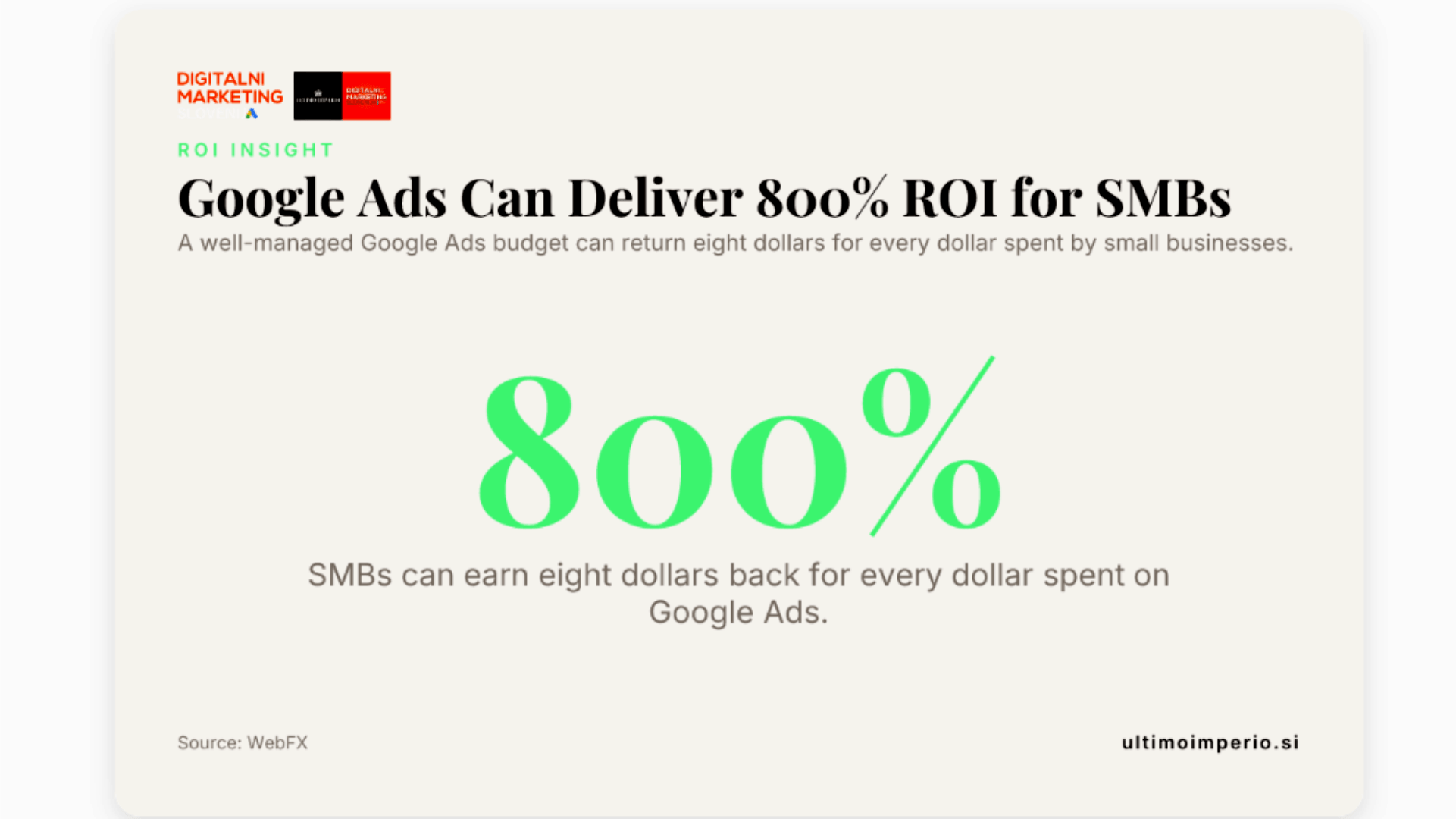
800% estimated ROI is possible with Google Ads when budgets are paired with the right conversion tracking and optimization cycle.
Source: WebFX
[Budget Protection] Use Guardrails So Your Spend Does Not Drift
Here is the uncomfortable truth. When you let bidding run freely, it will chase “more.” And “more” can mean more clicks, not more conversions. So top Google Ads Budget Tips for SMBs focus on budget protection in 2026.
So you, as you optimize, you also manage drift. We set boundaries so AI-driven bidding does not steer your budget toward low-quality traffic when conversion signals get weak.
- Set clear conversion goals. If you optimize for the wrong conversion, you fund the wrong outcomes.
- Segment budgets by intent. Keep high-intent search campaigns separated from discovery campaigns.
- Use negative keywords. This is one of the fastest ways to prevent budget waste on irrelevant queries.
- Review search terms weekly. In 2026, weekly review is not “nice to have,” it is the minimum protection for a limited budget.
So, as you probably already know, Google no longer wants Smart Bidding to exceed its goals. That's why you must feed the system with clean signals and then watch it, especially after changes.
[Google Ads + AI] Budget Discipline in a World of PPC + AI
AI is not “set and forget.” In 2026, PPC + AI works only when you structure campaigns so the model has something meaningful to optimize against. Otherwise you get spend, but not the results you planned for.
We approach it as a measurable workflow. We focus on measuring, analyzing, and optimizing for the best results. That's how you keep your Top Google Ads Budget Tips for SMBs from turning into random trial-and-error.
- Start small, but start structured. Use a tight keyword set and a clear conversion goal, then expand.
- Improve landing page consistency. If the ad promises one thing and the page delivers another, your budget pays for disconnects.
- Use audience signals responsibly. In remarketing and video, budget can scale quickly, but only when you understand who you are targeting.
- Document changes. If conversions drop after an update, you need a timeline to diagnose it.
If you want a perspective on how we think about AI in Google ads management, read our internal view on PPC + AI.
Did You Know?
50% — PPC visitors are 50% more likely to purchase than organic visitors, demonstrating why paid search is often a more direct path to revenue for small businesses.
Source: WebFX
[How to Stretch Budget] Match Landing Pages to Ad Intent (Without Burning Time)
This is where SMB budgets often leak. You pay for clicks, then you send visitors to pages that do not answer the exact reason they clicked. In 2026, you should treat landing pages as part of your budget system.
A practical statistic to keep in mind is that using a personalized landing page can make PPC campaigns 5% more effective. That is not a magic number, but it is a clear reminder that “relevant click to relevant page” matters for efficiency.
When you run google advertising as part of a measurable approach, the goal is simple, reduce waste, not just increase traffic. That means the landing page and the ad copy must align with the same intent.
- Match the headline claim: If your ad says “pricing,” the page should show pricing quickly.
- Keep forms short: Your budget should not be spent on friction.
- Track conversions you care about: Not every form submit is a qualified lead.
And yes, budgets are limited. That is why we design a practical testing plan, so every change teaches you something you can use next week.
[Budget Tools & Workflow] Build a Simple Weekly Optimization Routine
Top Google Ads Budget Tips for SMBs are boring on purpose. In 2026, the winners do not rely on one-off “big moves.” They run a weekly routine, review performance, adjust budgets and targeting, then measure again.
Our workflow is built around measurement and iteration. Instead of guessing, we analyze which campaigns produce conversions, which keywords steal spend, and which audiences need clearer messaging.
- Monday: Check conversion volume, cost per conversion, and top search terms.
- Tuesday: Add negative keywords and tighten query matching.
- Wednesday: Review ads and landing page performance, keep only what converts.
- Thursday: Adjust budget distribution across intent segments.
- Friday: Report results and plan next week’s tests.
For owners who also manage multiple channels, we recommend you review budgets in parallel, so google advertising does not get compared with channels that have different conversion paths. If you want a broader view, compare how we handle other platforms like Microsoft advertising for search demand expansion.
[Stay Current in 2026] Adapt to System Changes Instead of Reacting
Google changes things. Your task is to react less and prepare more. In 2026, the budget impact comes from system behavior and how bidding responds to your conversion signals.
When bidding systems get updated, you need to know what changed and how it affects your spending pattern. That is why we keep a close look at the platform and how it evolves. If you want an example of how we handle change management, read our take on Googlova sprememba sistema ponudb, kako se z njo spopadem.
- Before changes: Save your baseline metrics (conversion rate, cost per conversion, volume).
- After changes: Watch for budget drift and conversion shifts in the first reporting window.
- Only then: Apply structured adjustments, not random bid nudges.
Our ability to push the boundaries of digital marketing and challenge the status quo lies in our deep understanding of digital user behavior. That means we treat budget as a behavioral system, not just a number in a spreadsheet.
Conclusion
Top Google Ads Budget Tips for SMBs in 2026 boil down to one principle, spend based on intent and protect your budget with measurement and guardrails. When you run google advertising with a weekly optimization routine, align landing pages to ad promises, and keep PPC + AI structured, your budget stops bleeding and starts earning conversions.
A well-managed Google Ads budget can return eight dollars for every dollar spent by small businesses.
Frequently Asked Questions
What are the best Google Ads budget tips for SMBs in 2026?
The best Google Ads budget tips for SMBs in 2026 are to fund high-intent Search Ads first, protect spend with negatives and conversion-based guardrails, and optimize weekly based on cost per conversion. This is the practical way to make google advertising cost-efficient instead of click-heavy.
How much should an SMB spend on Google Ads per month in 2026?
Many SMBs start somewhere in the $100 to $10,000 monthly range, then scale only after conversion data stabilizes in 2026. The right number depends on your margin, lead value, and how quickly you can improve landing pages and keyword targeting.
Why is our google advertising budget getting wasted even when clicks look high?
Most wasted budgets happen when ads attract traffic without matching landing page intent, or when conversions are tracked in a way that rewards low-quality actions. In 2026, PPC + AI still needs clean conversion signals and weekly search term review to prevent drift.
Should SMBs run Google Display Ads or focus only on Search Ads in 2026?
In 2026, SMBs should focus on Search Ads for budget efficiency, then add Display Ads only if you can tie audience targeting and creatives to conversion outcomes. Display can spend quickly, so it needs measurement discipline and clear audience strategy.
How do I stretch a limited Google Ads budget without lowering lead quality?
Stretching budget in 2026 means improving relevance, not cutting quality. Use landing pages that match the ad promise, segment campaigns by intent, and use negatives so google advertising spends on queries that actually indicate buying behavior.
Is PPC + AI enough to manage Google Ads budget automatically in 2026?
PPC + AI helps, but it is not enough by itself. In 2026, you still need budgeting structure, conversion goals, negative keyword hygiene, and a routine for reviewing performance so the system optimizes toward the outcomes you want.
Can we manage Google Ads budgeting ourselves, or do we need expert help?
SMBs can manage budgeting themselves if they commit to weekly optimization and strict conversion tracking, especially for google advertising. If you do not have the time to review search terms, tighten targeting, and respond to system changes, expert management usually saves budget by reducing waste.
Contact us for optimized online advertising on Google | LinkedIn | X | Bing | Meta Ads or for a free review and analysis of your advertising account.: 041 512 565.


Related Articles



ULTIMO IMPERIO
smo mednarodna ekipa strokovnjakov za digitalni marketing in design.
Naša zmožnost premikanja meja digitalnega trženja in izzivanja statusa quo leži v globokem razumevanju vedenja digitalnih uporabnikov ter v zagotavljanju učinkovitega in merljivega pristopa k digitalnemu trženju za naše stranke.
Osredotočeni smo na merjenje, analiziranje in optimizacijo – za doseganje najboljših rezultatov!
Informacije
E-Novice
Prijavite se še danes za namige, nasvete in najnovejše novice.
